Brainscan (1994): more interesting than it appears?
A few days ago, I had the tremendous pleasure of watching Brainscan (1994), a film in which a teenager plays a computer game that seems more ‘real’ than ‘unreal’ — he stops playing his first session only to discover that the man he murdered in the game has been killed in the real world.
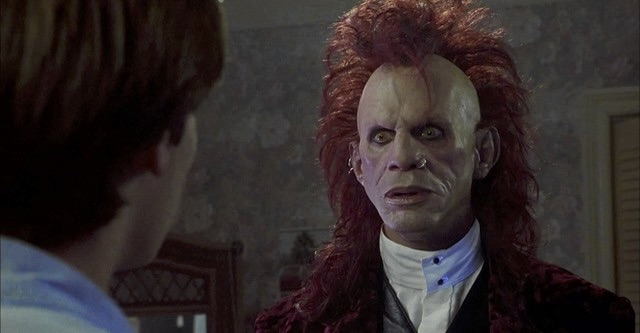
The Trickster, via Park Circus.
From there we meet the ‘Trickster’, the host of the game. Imagine Beetlejuice, but digital, and more into metal. The Trickster convinces our teenage protagonist Michael to play through the following 3 discs of 'Brainscan', which claims to assess the player’s mind for a more ‘tailored’ experience. Of course, playing the discs results in more deaths, culminating in a confrontation between Michael, the Trickster, a police detective, and Michael’s crush, Kimberly. The detective shoots Michael, whom he has identified as the killer… and Michael jolts back to ‘reality’. He has been playing the first (and in fact only) disc of Brainscan this entire time, and all of the previous killings and troubles were simply part of the game’s intended gimmick — the ultimate experience in terror, or something along those lines.
This may seem like a bit of a cop-out, but there are still several unanswered questions, not least due to the fact that the Trickster reappears after Michael finishes playing the game. Some forensic evidence (a severed foot, to be exact) also still exists in the ‘real world’, shown in a sequence that intrudes upon the end credits.

The mid-credit scene of Brainscan, which complicates its ending.
Overall, the film seems to be making the point that video games and horror movies don’t cause violence, people do. Michael remarks as much to his principal, who does not approve of his school horror club on the basis that “senseless violence is not entertainment”. Michael’s reply sets up the discourse within which the film operates: “What is it, then?”
The idea that violent entertainment does not cause real-life violence is particularly hammered home in a scene where citizens (who have formed a neighbourhood watch to catch the killer apparently stalking their town) mistakenly shoot a police officer. Violence happens: everyone is capable of it, regardless of whether they watch horror movies or play violent games.
That’s a reasonable message for a tech-horror film from the 90s, but there’s something deeper to this movie. Not only does it contain horror elements, it celebrates horror, and I think it points to ways in which horror helps us feel good, or helps us heal. This essay aims to illustrate the ways in which Brainscan explores the relationship between depression and horror, and to show that — in this respect — it is a well-crafted and interesting film. With a 13% on Rotten Tomatoes ‘Tomatometer’ and 3 stars on Letterboxd, I feel that my interpretation is not widely shared, and has perhaps been overlooked.
Illness
Leading up to the climax of the film (the confrontation in which Michael is shot), certain lines from the Trickster reveal a Jigsaw-esque motivation to force Michael to improve his life — by any means necessary. The Trickster takes credit for Michael and Kimberly confessing their feelings, saying “I knew you couldn't do it on your own”. This suggests that the character of the Trickster is less of a menacing villain, and more like, well, a Trickster. He exists to teach a lesson. But what lesson, exactly?
Most telling is a line (delivered with spectacular subtlety by T. Ryder Smith’s Trickster) that can be read multiple ways.
You started this, and now you're afraid to finish it, just like you're afraid of everything else! Of Kimberly, of Fromberg, of telling your father how sick you are of being left alone all the time. Of your mother, who abandoned you.
This line comes as the Trickster attempts to turn Michael against Kimberly. Later in the film, the Trickster even urges Michael to kill her. As she saw him return home late after curfew, she is a witness, and the Trickster suggests that Michael removes her, asking him to value his own life. On the surface, this is the lesson that the Trickster is trying to teach: that Michael is weak and afraid, and needs to take charge his destiny. However, there is another reading of this line that reveals a slightly different motivation.
You started this, and now you're afraid to finish it, just like you're afraid of everything else! Of Kimberly, of Fromberg, of telling your father how sick you are, of being left alone all the time. Of your mother, who abandoned you.
Smith’s excellent delivery does contain a very small pause between “are” and “of”, and it seems reasonable to interpret this as a separation between two clauses. The structure of the sentence means it still makes grammatical sense, too. Whether this was intentional or not on the part of the filmmakers is debatable, but after going through a few rewrites, I’d argue that it is. This interpretation introduces the theme of sickness. Combined with the noose we see hanging from Michael’s ceiling in this scene — never mentioned directly, and apparently part of his decor — it’s not hard to guess exactly what kind of illness the Trickster may be referring to.
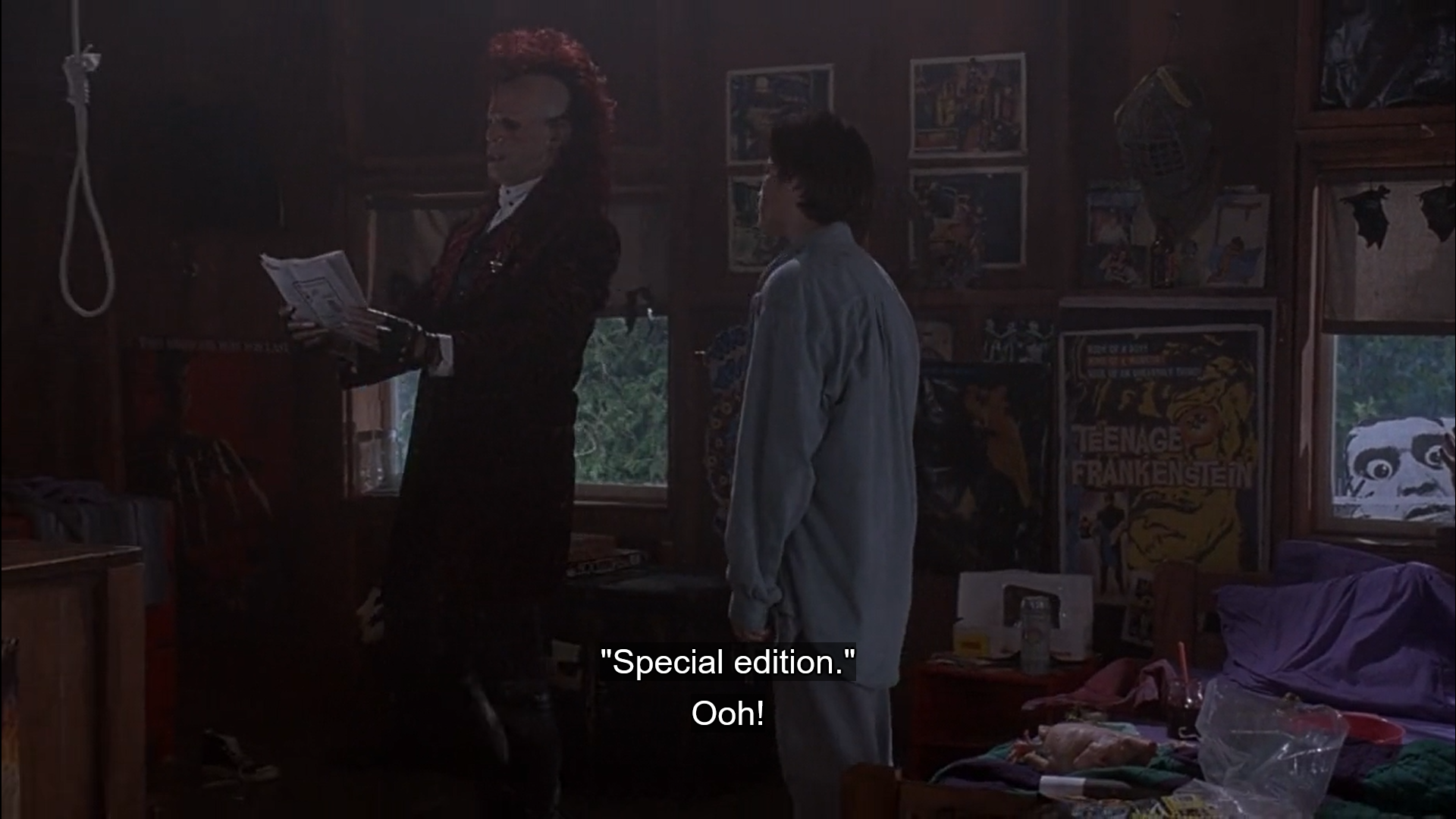
As far as the implications for the story, well — who among us hasn't been a depressed teenager? We can't tell our parents because they won't understand, they might react badly, it might scare them (or break their hearts). Read this way, Brainscan becomes a film not only about horror, but mental illness and horror, specifically depression and horror. The theme of illness is also signalled by the title: what is a brainscan? What are they used for, medically? Based on this, I don't think my reading is being pulled out of thin air.
Horror and heartrate
How else does Brainscan show the interactions between horror and mental illness? Well, a physiological component is certainly present. I don't know about you, but when I started watching horror movies as a depressed teenager, it was quite helpful for me in a physical way. Watching a horror movie increases your heart rate, and releases cortisol and adrenaline, as well as dopamine. You can feel a sort of ‘high’ of endorphins, similar to what you might receive from exercise.
Although Michael is stressed by the circumstances he finds himself in for most of the film, he is also clearly more animated and more invested in his life than he was before he began playing Brainscan. The horror gets his blood pumping. After playing the first disc, he seems thrilled by the experience, sweat pouring down his face. This is taken to the extreme after the game’s actual conclusion — Michael is exuberant, acting out; he breaks things, he rushes outside to see his best friend, exclaiming that he loves him and is glad to see him. He runs over to the house party next door — something that he would not have done at the beginning of the film — and asks Kimberly to go out with him. All of this ultimately legitimises the character motivation of the Trickster, who seems to be psychologically tormenting Michael into caring about his own life; on a broader scale, it speaks to the physical and mental benefits of giving yourself a good scare.
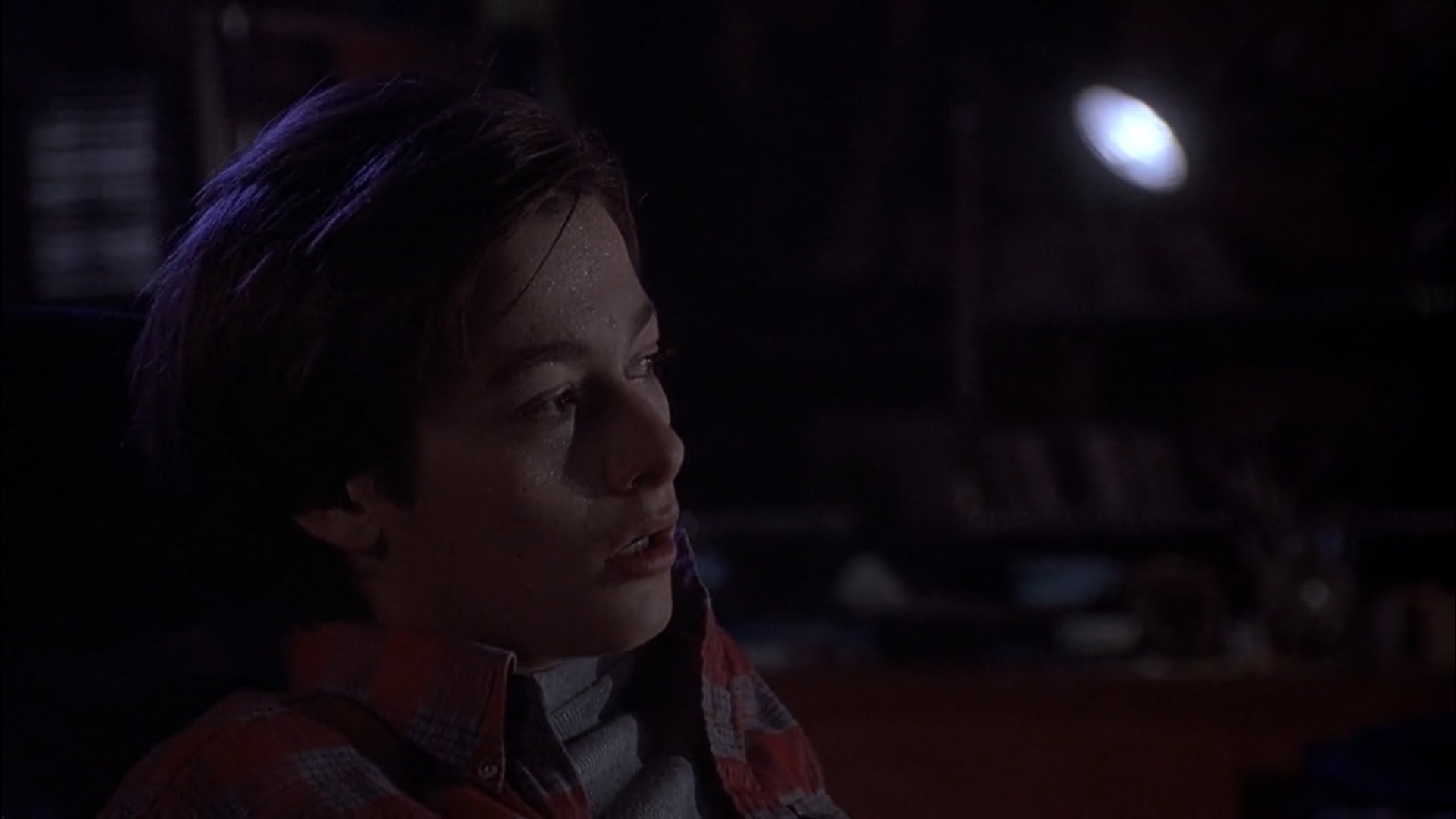
The sweat on Michael's forehead shows how much of a workout he's been through.
Numbness
Watching horror movies and playing horror games can help you feel something, not just physiologically, but emotionally. Depression often numbs you to your own life; whatever happens, you may simply feel empty. This seems to be something that Michael is struggling with from the outset of the film. He has been left injured by an accident that killed his mother. As he moves through his life, talking to friends, discussing movies with his horror club, getting chewed out by his principal, and apparently being neglected by his father (away on business, leaving a single voicemail for the several-day scope of the film), Michael’s disappointed but disaffected attitude does not change. He feels nothing.
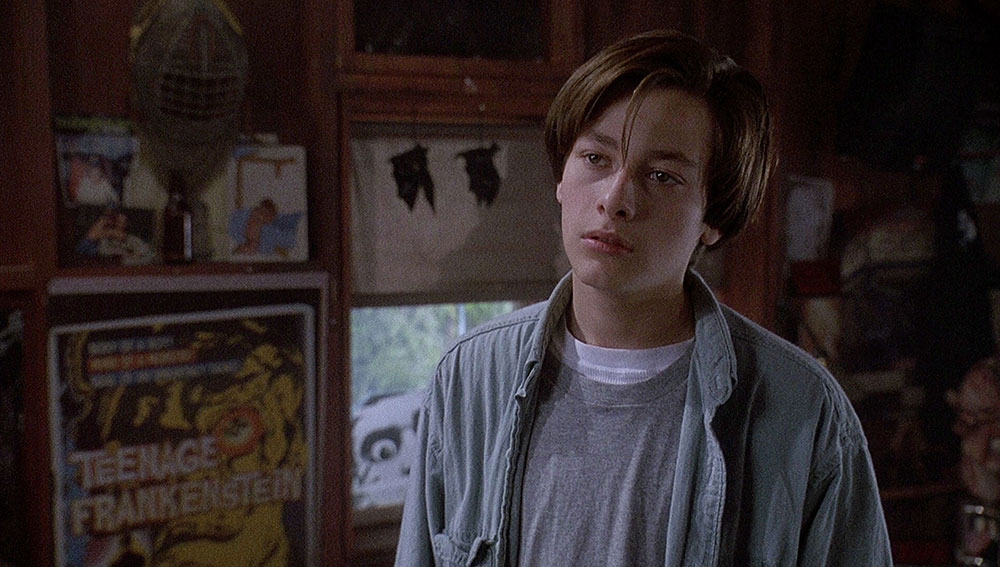
Michael's numbness on screen, Movies Films and Flix.
Although his problems have not beein entirely resolved by the end of the film — Michael does not mention his mother’s death after he finishes playing Brainscan, but I think it’s safe to say he still hasn’t completely processed that, and his father has still not appeared — he does seem to be healthier and happier. It also seems that he has been forced to recognise other people’s emotions and interior worlds. Once again, speaking for myself, if I am particularly ill, the world seems to collapse in on itself. I go into survival mode; if I don’t make a significant effort, I recognise nothing except what’s happening in my own brain. Other people’s lives become inaccessible.
At the climax of the film, the Trickster attempts to convince Michael to kill Kimberly. But ultimately, despite Michael’s numbness and introspection, he refuses to do so — only after Kimberly reveals that, while Michael watches her from his window, she also watches him. Kimberly produces photographs she has taken of Michael as proof. This forces Michael to recognise that killing Kimberly is wrong not only because it will be bad for him (emotionally, legally), but because she is her own person with agency, leading her own life. Another symptom of his depression has been — not cured, but at least addressed by the game, and thus the film.
You could certainly interpret this climactic moment differently. On the surface, it appears to be a scene in which a female love interest reveals that the male protagonist’s love is requited, saving her from his jealous or impotent retribution. But this does not quite fit with the rest of the text, particularly as Michael’s motivation for his apparent ‘killing’ is based on self-preservation, not anger at Kimberly. Instead, this reading of the climax as ‘recognition of the other’ is further evidenced by the final scene of the film (excluding the mid-credits scene). Michael’s principal (Fromberg) has demanded to vet each movie or game before it is shown to Michael’s horror club. Michael hands Fromberg the copy of Brainscan with amusement, commenting “I think you’ll have a lot of fun”. Here, the Trickster emerges once again, manifesting behind Fromberg with a grateful and playful wave at Michael.
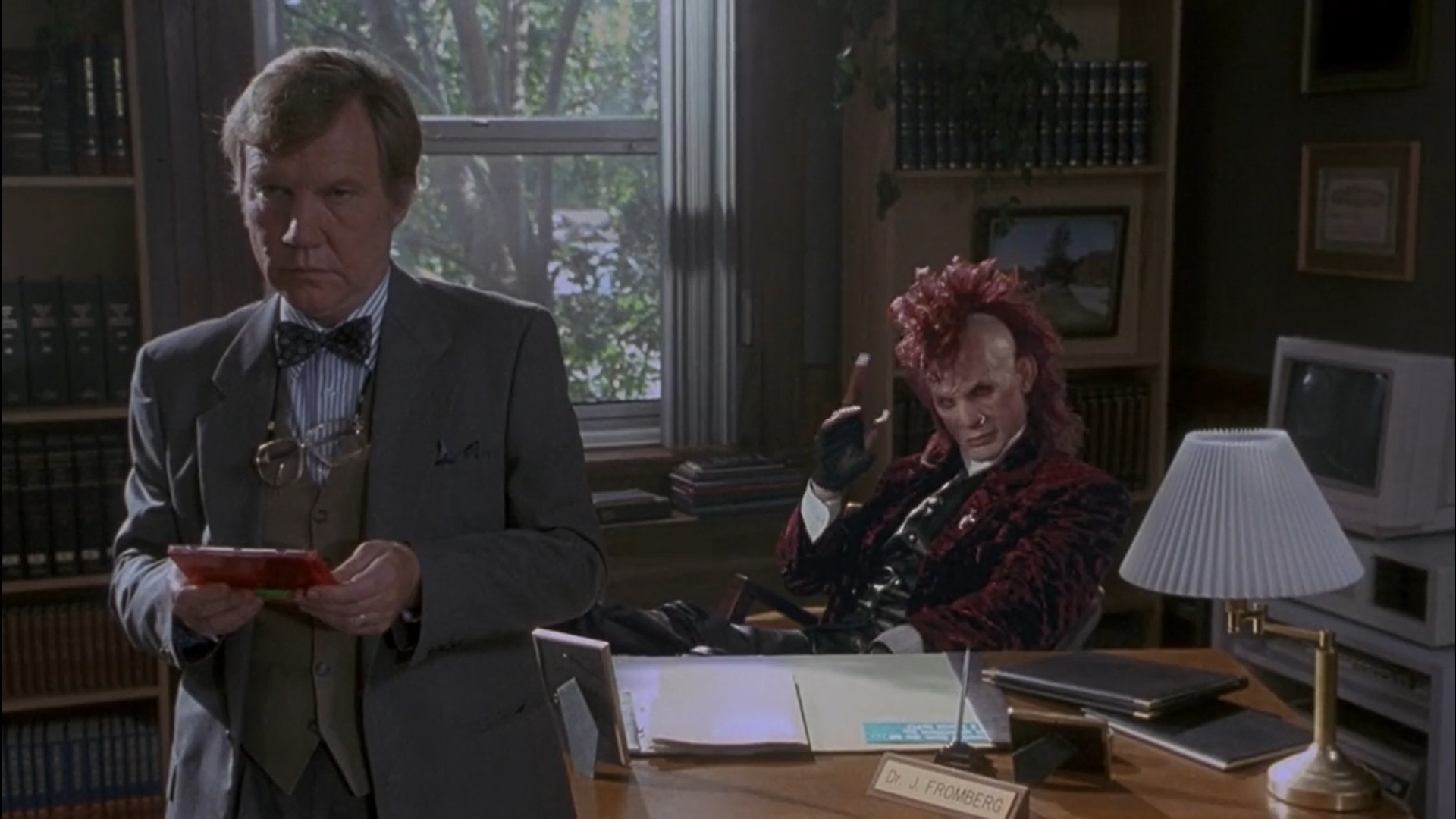
Michael's principal, Fromberg, is about to have the worst (or possibly best) gaming experience of his life.
You can interpret this scene as Michael getting ‘payback’ for Fromberg’s reprimanding (and of course, that is true to some extent), but there is a different quality to the performance and tone. Rather than seeming malicious, the Trickster appears excited to teach someone else a useful (but likely harsh) lesson. Michael knows that Fromberg will not ultimately be harmed, just scared. This is not a vengeful action, but one that seeks to teach the principal the utility of horror and the reality of violence. Rather than seeing Fromberg as a simple obstacle in the architecture of his own life, Michael now recognises Fromberg as another person, who can learn and benefit and change.
Conclusion
Brainscan, taken at face value, can be read as a mildly entertaining film about violence and horror, making a point about every person’s capacity for harm. But this reading omits the film’s most interesting aspects: its celebration of the horror genre, its concern with illness, and the change in Edward Furlong’s performance at the end of the movie. Examined in more depth, we can instead read Brainscan as an exploration of the relationship between horror and depression, which illustrates how and why depressed people may be drawn to and take refuge in horror. Despite its flashy effects and hard-rock soundtrack, it approaches this subject with surprising respect and subtlety. Whether Brainscan is ‘good’ or not is outside the scope of this essay, but I hope I have at least showed that it’s far more interesting than it was ever given credit for.

Thanks for reading! You can follow me on Letterboxd, if you like.